
A payment application (commonly referred to as a "pay app") is a formal, documented request submitted by a contractor to an owner or general contractor to request payment for work completed during a defined period of a construction project. Unlike a standard invoice, a payment application provides a structured, detailed accounting of all work performed to date, amounts billed in prior periods, amounts requested in the current period, and any retainage withheld—giving all parties a clear, consistent picture of project financials at every stage of construction. 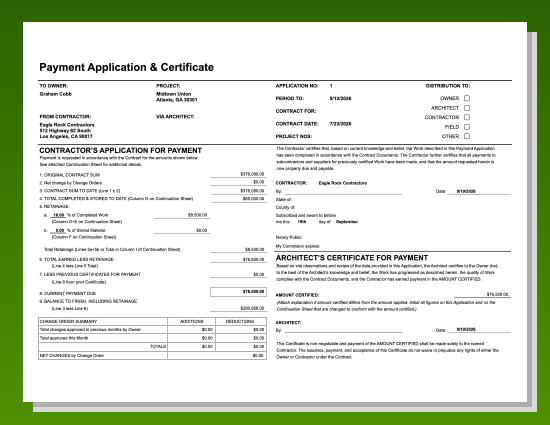
Payment applications are most commonly required on commercial, multi-family, and larger-scale construction projects, where structured progress billing is a standard condition of the contract. In these environments, formal documentation is expected by owners, lenders, and architects before any payment is authorized.
PROGRESS BILLING IN CONSTRUCTION
Most construction contracts aren't paid in a single lump sum. Instead, payment is distributed incrementally as work is completed—a practice known as progress billing. Payment applications are the mechanism through which progress billing is formalized and documented. At the end of each billing period, the contractor submits a Payment application that details how much work has been completed, how much has already been paid, how much retainage has been withheld, and how much is currently due.
This structure benefits all parties. Owners gain transparency into how project funds are being drawn against completed work. Contractors establish a clear, documented record of payment requests that can be referenced in the event of disputes. And lenders or other financial stakeholders have the documentation they need to authorize draws against construction financing.
THE INDUSTRY-STANDARD FORMAT
The construction industry has long relied on a widely recognized, standardized format for payment applications—one that establishes a consistent structure for contractors to request payment and for architects to certify the amount due. This format is used across commercial and multi-family projects nationwide and is familiar to owners, architects, lenders, and general contractors regardless of company or region.
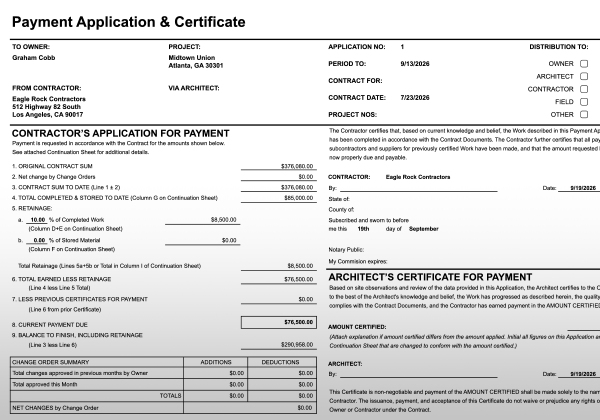
This standard approach typically consists of two components: a cover sheet presenting the high-level financial summary, and Continuation Sheet(s) providing the full Schedule of Values in line-item detail. Together, they define what most commercial and multi-family projects expect to see when a contractor submits a pay app.
The cover sheet captures key figures including the Original Contract Sum, Net Change by Change Orders, Total Completed and Stored to Date, Retainage, and the Current Payment Due. The Continuation Sheet(s) break that summary down line by line across the full Schedule of Values, tracking completion percentages and amounts billed per line item across every billing period.
Because this format is so universally recognized across the construction industry, ConstructionOnline generates payment application exports that follow these same widely accepted conventions, ensuring that documents are immediately familiar to owners, architects, and lenders regardless of what software was used to produce them.
WHY MANUAL PAY APP PREPARATION FALLS SHORT
Historically, the preparation of payment applications has been a labor-intensive process, requiring contractors to manually compile information from estimates, change orders, and prior billing records into the standardized format, often using spreadsheets or standalone document templates. Without a connected system, this process is prone to errors, duplicate data entry, missed change orders, and inconsistencies between what was contracted and what was billed. These discrepancies can lead to payment disputes, rejected applications, and strained client relationships—all of which slow down cash flow at a time when it matters most.
PAYMENT APPLICATIONS IN CONSTRUCTIONONLINE
As part of ConstructionOnline's industry-leading suite of connected financial management tools, Payment Applications are designed to help contractors generate formal, professional requests for payment—formatted to industry-standard conventions—without recreating data from scratch. By integrating directly with Project Estimates, Change Orders, and Invoices already stored in ConstructionOnline, users can produce accurate, complete Payment Applications in a fraction of the time, with built in safeguards that prevent duplicate billing and protect previously submitted records from modification.
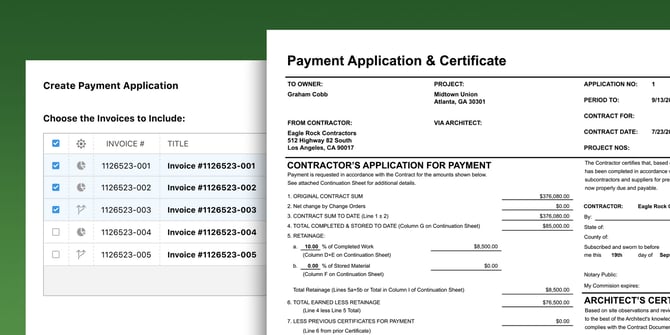
The exported Payment Application document from ConstructionOnline includes a Contractor's Application for Payment, an Architects Certification for Payment, a Change Order Summary, and detailed Continuation Sheet(s).
Payment Applications in ConstructionOnline are available to customers at the Business or Enterprise levels of ConstructionOnline's Commercial, Specialty, and Multifamily subscriptions.
🗒️ Note: For a detailed explanation of how Payment Applications work inside ConstructionOnline—including setup, data sources, document structure, and status tracking—see the Guide to Payment Applications in ConstructionOnline™.
PAYMENT APPLICATION KEY TERMINOLOGY
-
Payment Application (Pay App): A formal, structured request for payment submitted by a contractor to an owner or GC for work completed during a defined billing period.
- Progress Billing: The practice of billing incrementally as work is completed over the course of a construction project, rather than in a single lump sum.
- Payment Application and Certification: The title of the exported Payment Application document generated by ConstructionOnline, formatted to industry-standard conventions.
-
Schedule of Values (SOV): A detailed, line-item breakdown of the total contract value, organized by work category, used to track the percentage of completion and amounts billed per line item across billing periods.
-
Continuation Sheet: A supporting document attached to a Payment Application that provides the full Schedule of Values detail, including amounts from prior applications, amounts requested in the current period, total completed and stored to date, retainage withheld per line item, and balances to finish.
-
Original Contract Sum: The total contract amount prior to any Change Order adjustments, calculated from the Project Estimate.
-
Net Change by Change Orders: The net value of all Change Orders included in the current or previous Payment Applications, reflected as additions and/or deductions to the Original Contract Sum.
-
Contract Sum to Date: The Original Contract Sum adjusted by the Net Change by Change Orders.
-
Total Completed & Stored to Date: The cumulative value of all work completed and materials stored across all Payment Applications on the project through the current billing period.
-
Retainage: A percentage of each payment withheld by the owner until substantial completion or other contractually defined milestones are reached. Retainage is calculated separately for completed work and stored materials.
-
Total Earned Less Retainage: Total Completed & Stored to Date minus total Retainage.
-
Less Previous Certificates for Payment: The total amount certified for payment in all prior Payment Applications.
-
Current Payment Due: The net amount being requested in the current billing period, calculated as Total Earned Less Retainage minus Less Previous Certificates for Payment.
- Balance to Finish, Including Retainage: The remaining contract value yet to be billed, calculated as Contract Sum to Date minus Total Earned Less Retainage.
- Change Order Summary: A table on the Application Cover summarizing Change Order additions and deductions approved in previous pay periods, approved in the current period, and the net change total.
-
Contractor's Application for Payment: The certification section of the Payment Application in which the contractor affirms that work has been completed in accordance with the contract documents and that all prior payments to subcontractors and suppliers have been made.
-
Architects Certification for Payment: The section of the Payment Application completed by the architect certifying the amount approved for payment based on observations and review of the application.
- Status: Used to track the current stage of a Payment Application through the billing lifecycle. Available statuses are In Progress, Submitted, Approved, and Rejected. Once users set a Pay App to Approved status, a Payment Application may be marked as Paid.
ADDITIONAL INFORMATION
- Subscription Level: ConstructionOnline's Payment Applications are available for companies using ConstructionOnline Commercial, Specialty, or Multi-family subscriptions at the Business or Enterprise level.
- The Payment Applications feature is also available as a Per-Company Add-On for all other plans.
-
CO™ Mobile App: Currently, the Payment Applications feature is exclusively available through browser access to ConstructionOnline.
HAVE MORE QUESTIONS?
- Frequently asked questions (FAQ) about Payment Applications can be found in the article FAQ: Payment Applications.
- If you need additional assistance, chat with a ConstructionOnline Specialist by clicking the orange Chat icon in the bottom left corner or visit the UDA Support Page for more options.